
The final day of the 2026 UCI Track Cycling World Championships in Shanghai delivered a fitting end to five days of world-class racing. Harrie Lavreysen extended his extraordinary run in the men’s individual sprint, winning his eighth consecutive world title in the discipline and bringing his total number of world titles across the sprint disciplines to 23. Denmark dominated the men’s Madison, while Ireland’s Lara Gillespie won the women’s points race and Alina Lysenko took the women’s keirin in a finish decided by just thousandths of a second.
From tactical battles in the bunch races to decisive performances in the sprint events, the final day highlighted the variety that makes track cycling so compelling.
Men’s Sprint: Lavreysen Extends His Reign
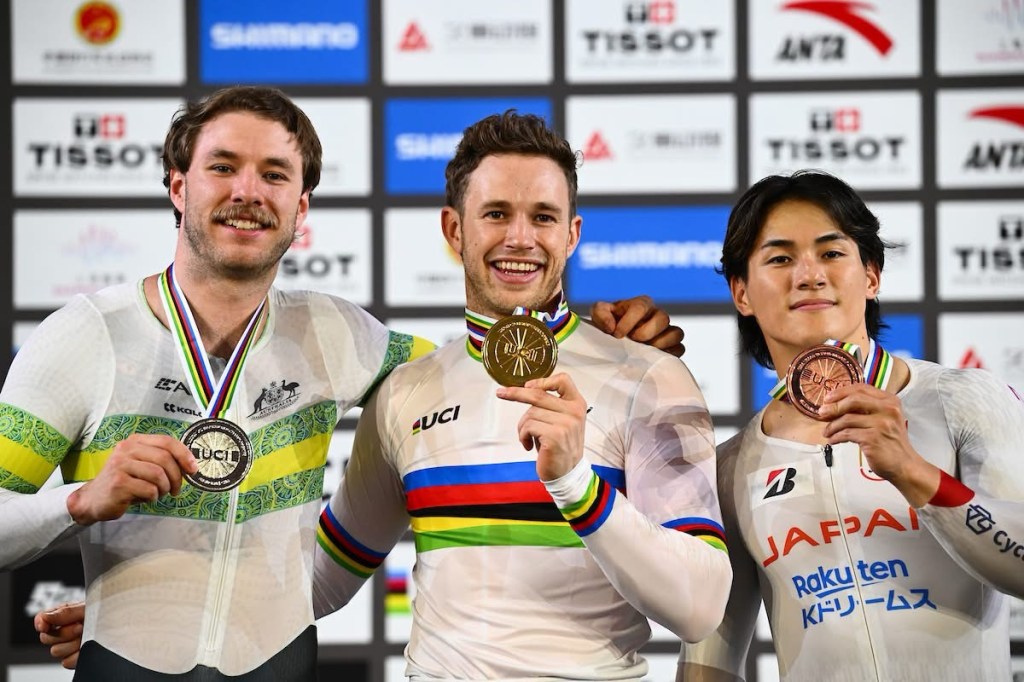
Harrie Lavreysen added another chapter to his remarkable career by winning his eighth consecutive world title in the men’s individual sprint.
The Dutchman had not been the fastest rider in qualifying. Australia’s Leigh Hoffman topped the 200m flying-start rankings in 9.285 seconds, with Lavreysen second in 9.426.
The final, however, told a different story. Lavreysen defeated Hoffman in straight rides, winning the first by 0.093 seconds and the second by 0.183. It was a convincing performance that once again demonstrated why qualifying times alone rarely tell the full story in sprint cycling. Tactical positioning, acceleration and the ability to judge the decisive moment are just as important as raw speed.
The bronze-medal contest was also won in two rides, with Japan’s Kaiya Ota defeating Trinidad and Tobago’s Nicholas Paul. Ota won the first ride by 0.052 seconds before securing the bronze with a 0.256-second margin in the second.
Lavreysen’s latest victory takes his world-title tally across the sprint disciplines to 23, further cementing his place among the most successful riders in track cycling history.
Men’s Elimination: Teutenberg Wins the Tactical Battle
Germany’s Tim Torn Teutenberg claimed the men’s elimination title ahead of Denmark’s Tobias Hansen, with Belgium’s Jules Hesters taking bronze.
The race was marked by two incidents that demanded quick reactions from the riders. First, Spain’s Xavier Cañellas Sanchez suffered a puncture and returned to the track on a teammate’s bike. A yellow flag was displayed, but the race was not stopped and the other riders continued circulating.
Later, Matteo Fiorin crashed. Cañellas narrowly avoided the Italian rider by the smallest of margins, showing remarkable reflexes while still riding the borrowed bike. The Spaniard was eliminated in the following elimination, while Fiorin went out shortly afterwards. Although it is impossible to establish how much the crash affected Fiorin, the incident added another layer of unpredictability to the race.
The final was decided by a clever tactical choice. Teutenberg deliberately began the sprint from a relatively low speed, taking advantage of his more favourable gear ratio. He moved onto the inside line and held the lead all the way to the finish, leaving Hansen without the space to come around him.
It was a victory built not only on power, but also on race awareness and the ability to make the right decision at the right moment.

Women’s Keirin: Lysenko Wins by Thousandths
The women’s keirin final produced one of the closest finishes of the championships.
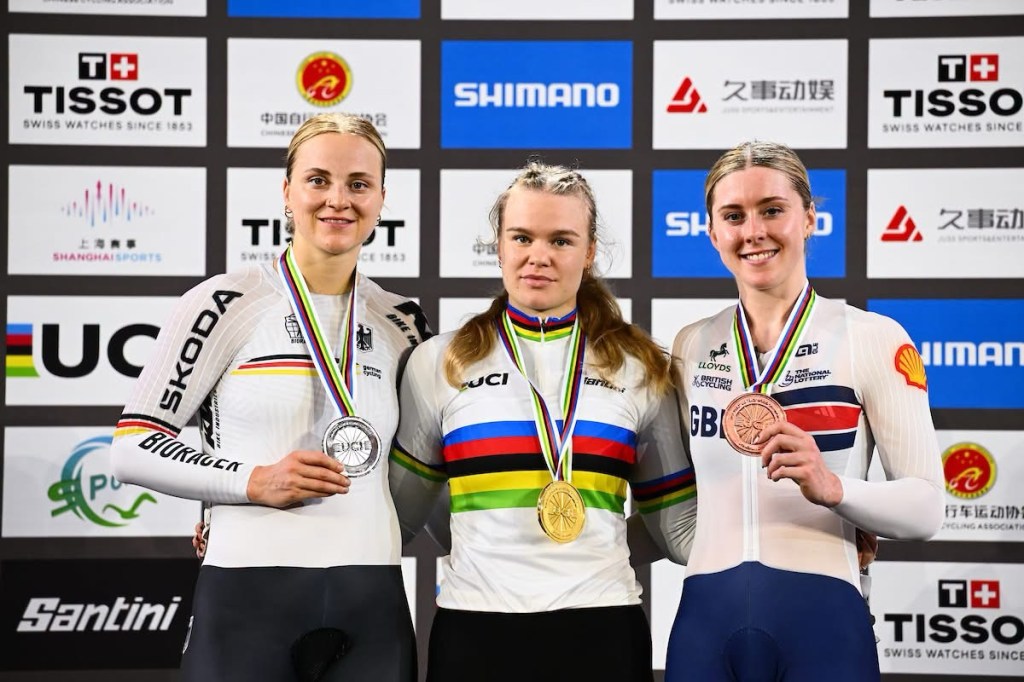
Great Britain’s Emma Finucane appeared to be in control as the riders entered the final straight. Germany’s Sophie Friedrich then came charging back in the closing metres, but Alina Lysenko, riding even wider, found the decisive acceleration to pass both rivals and take the world title.
The final times underline just how close the contest was. Lysenko won gold, Friedrich took silver just 0.006 seconds behind, and Finucane secured bronze at 0.014 seconds.
The first three riders were separated by only 14 thousandths of a second. In a race where position, timing and the ability to accelerate at precisely the right moment are crucial, Lysenko found the winning line when it mattered most.
Women’s Points Race: Gillespie Delivers When It Counts
Ireland’s Lara Gillespie won the women’s points race after a contest in which gaining a lap proved crucial to the battle for the medals.
The 25km race featured ten intermediate sprints, but the key moves came away from the sprint line. American rider Anna Hicks was among the first to break clear and gain a lap on the bunch, temporarily putting herself in contention. She later lost that advantage and finished sixth with nine points.
The decisive factor was the ability to gain a lap. Gillespie, Denmark’s Amalie Dideriksen and Belgium’s Shari Bossuyt each gained a lap through individual attacks, building the advantage that ultimately separated the medal contenders from the rest of the field.
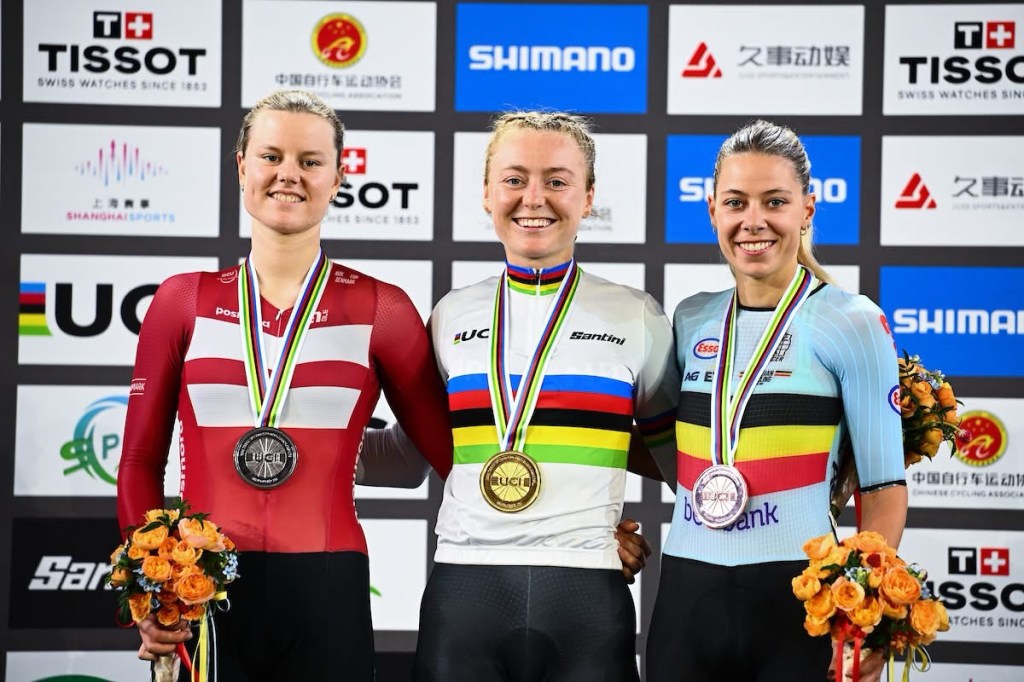
The contest remained open until the final sprint. Gillespie, one of the fastest riders in the field, took six points in the last intermediate sprint to secure the world title with 42 points.
Dideriksen finished second with 37 points, while Bossuyt took bronze with 35. Mexico’s Yareli Acevedo Mendoza won the final sprint but finished fourth overall on 13 points, having been unable to match the leaders’ lap gains.
The result rewarded three riders who combined tactical initiative with consistent sprinting. Gillespie then confirmed her speed in the decisive final moments, turning a strong overall performance into the world title.
Men’s Madison: Denmark Dominate a Race of Constant Attacks
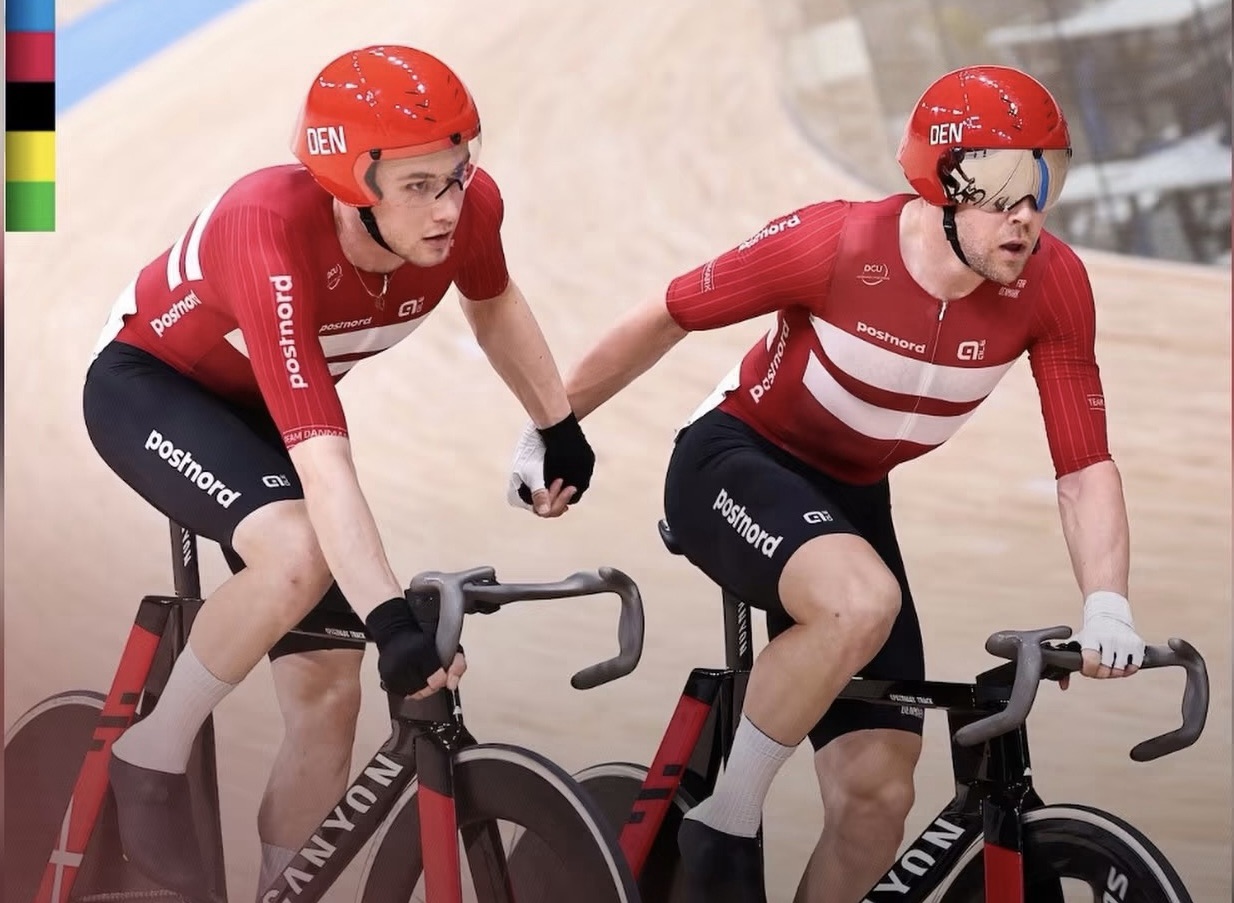
The men’s Madison traditionally closes the World Championships, and it proved a fitting finale in Shanghai. The 50km race, featuring 20 sprints, was an unpredictable contest in which the standings repeatedly changed as teams attacked, gained laps and tried to establish control.
From the early stages, it became clear that sprint points alone would not be enough to win. Gaining a lap on the bunch was essential to remain in contention for the medals.
The Netherlands Strike First
With 127 laps remaining, the Netherlands launched the first major attack. After winning a sprint, the Dutch pair gained a lap and moved into the lead. Until that point, all the points had come from the intermediate sprints.
With 112 laps to go, Portugal responded with an attack led by Iúri Leitão, the Olympic Madison champion from Paris 2024 alongside Rui Oliveira. Italy, Spain and France attempted to counter, but as the race approached the halfway point, the bunch split into several groups and the counterattack was brought back.
Portugal remained clear and gained a lap with 90 laps remaining. At the same time, Denmark launched a solo move.
With 74 laps to go, the Danish pair also gained a lap and moved into the fight for the lead. Portugal, Denmark and the Netherlands were among the leading teams as the race entered its second half.
A Constantly Changing Race
The action intensified with 58 laps remaining, when Germany gained a lap in just a couple of laps and moved temporarily into second place.
Great Britain and Belgium followed with lap gains of their own with 50 laps remaining. Italy, represented by Simone Consonni and Niccolò Galli, was still in contention for the podium and also gained a lap.
The race became increasingly difficult to follow. The bunch repeatedly fragmented, while fresh attacks changed the provisional standings. New Zealand also appeared to gain a lap, as Denmark continued to apply pressure.
With around 40 laps remaining, the field was once again spread across the track. Denmark launched another solo attack with 35 laps to go and secured its third lap gain with approximately 20 laps remaining. From that point, the Danish pair took firm control of the race.
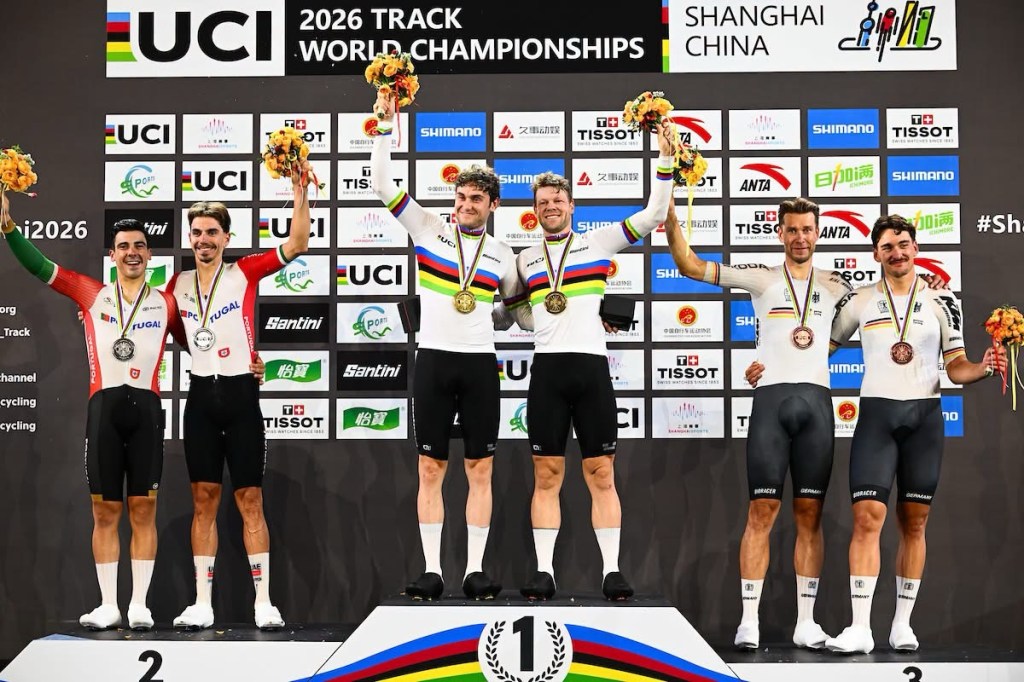
Denmark Take Gold with 88 Points
Denmark finished with 88 points, including 60 points from three lap gains, in a dominant performance built on well-timed attacks and excellent coordination between the two riders.
Portugal took silver with 67 points, while Germany secured bronze with 52. Belgium finished fourth on 51 points, just one point short of the podium.
Italy finished fifth with 40 points after gaining a lap and collecting points in the sprints. Consonni and Galli remained involved in the key moves throughout the race, but they could not match the number of lap gains and the overall scoring of the leading teams.
Great Britain finished sixth with 32 points, level with New Zealand and the Netherlands, who placed seventh and eighth respectively.
The Madison once again demonstrated that sprint speed alone is not enough. Teams must judge when to attack, work seamlessly together and identify the right moment to gain a lap. Denmark proved the most effective at all three, closing the championships with a commanding victory.
Looking Back on Shanghai
The final day captured the essence of track cycling: races decided by thousandths of a second, tactical decisions that can transform a contest, and endurance events in which a single attack can reshape the standings.
Lavreysen continued his remarkable dominance of the individual sprint, Gillespie combined tactical awareness with finishing speed to win the points race, and Denmark delivered a masterclass in the Madison.
Across the five days in Shanghai, the championships showcased the depth of international track cycling and the contrasting demands of its disciplines. The sprint events rewarded precision and explosive acceleration, while the endurance races highlighted teamwork, timing and the ability to read a constantly changing race.
With the final medals awarded, attention now turns to the next phase of the Olympic qualification cycle. The results in Shanghai provide an important early reference point, but the road to Los Angeles 2028 remains long, with further opportunities for riders and nations to build momentum, refine their strategies and strengthen their position on the international stage.

